Pakistani terrorists again flee after brief gunfight with security forces in Kishtwar forests
Two groups of Jaish-e-Mohammad (JeM) terrorists are active in the area.
“The Trial of Abdus Salam” the play directed by scientist Nilanjan P Choudhury which was first staged in April this year and which has received critical acclaim across the globe, was recently staged at Kolkata’s Bose Institute.




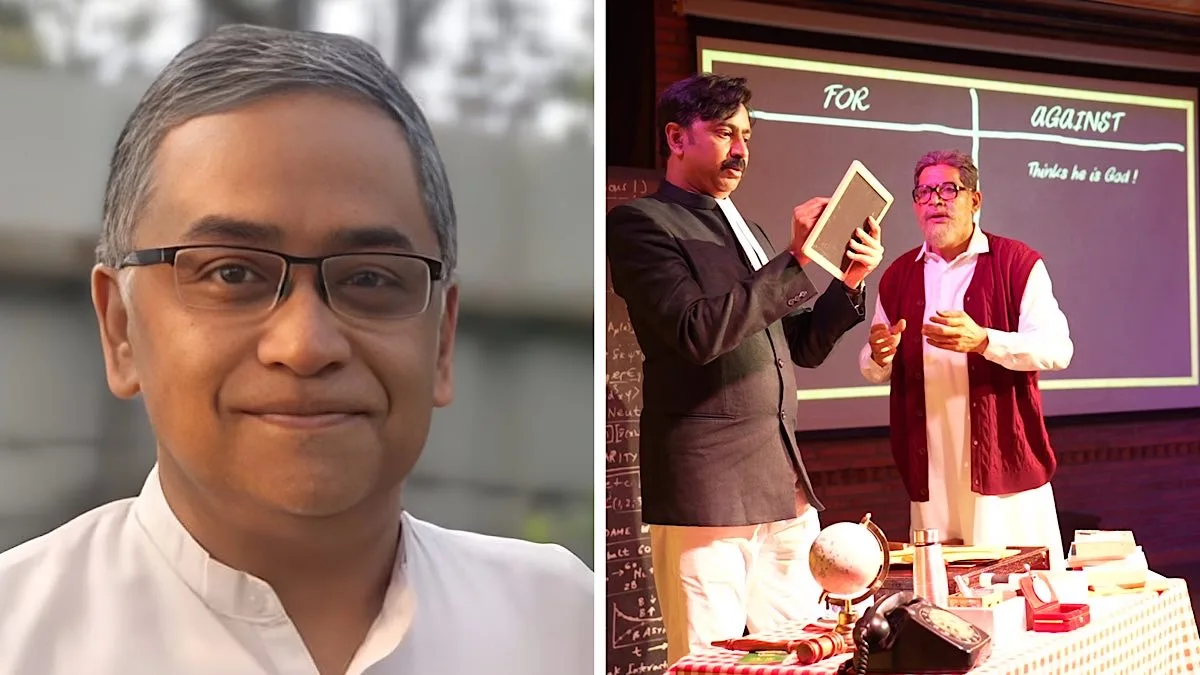
Photo:SNS
“The Trial of Abdus Salam” the play directed by scientist Nilanjan P Choudhury which was first staged in April this year and which has received critical acclaim across the globe, was recently staged at Kolkata’s Bose Institute.
Though it has widely been described as an “imagined courtroom drama” in which Salam, the Pakistani physicist who won the Nobel Prize in 1979 defends himself against allegations of heresy under a fictional enquiry, the production is a great deal more. Beneath the ostensible outer layer of the imagined interrogation lies a deeply poignant psychological discourse which examines and subsequently exposes the vulnerability of social thinkers around the world who are hounded and persecuted by nations, usually and especially by their own countries for the ideas of unity and universality that they propound.
Advertisement
Salam’s science revealed that there exists an innate connection between the so-called disparate forces of nature when he was able to successfully unify two of the four fundamental forces of nature – the electromagnetic and the weak nuclear fields. He extended, philosophically, this discovery to the inherent universality of humans and to the ultimate goal of religions. Pious, devout and a believer – contrary to the precept that science and spirituality are at conflicting and opposing polar ends – he felt that his scientific findings apply to life itself.
Advertisement
Choudhury conveys this complex idea masterfully through a script which is riveting and replete with powerful dialogue that is also at times rip-roaringly witty.
Yet a script, no matter how brilliant, could fall flat on its face if not in the hands of a set of good actors. Krishna Hebbale as Salam, shoulders the responsibility superbly. His sense of timing, including the pauses, the delivery of dialogue and the expressions of desperation as he gets into the skin of his character is remarkable. The scenes of the old and ailing scientist, living in exile in London, desperately trying to convince his country’s representative – the interrogator – that far from being an antinational heretic, he is a devoted religious man and all he wants is the right to be buried in his own land, tugs at the heartstrings.
Harish Seshadri playing the interrogator and (in brief appearances) other characters is himself remarkable as he conveys the role of the official who is in the unenviable position of having to interrogate, on behalf of his bosses, an individual who he secretly knows should be celebrated and put on a pedestal.
The props – different masks of world leaders, namely those whom Salam had interacted with during the span of his career, like Indira Gandhi – plays a key role as characters.
The production’s crew played a crucial role highlighting the fluctuating feelings of an old, ailing man as they oscillated between despondency and hope. Through the set and lighting Arun Murthy creates an atmosphere of the irony….where the world-renowned scientist who has reached the pinnacle of success sits in his cozy, comfortable London living room adorned with the photographs of his loving family, but who is besieged by the shadows of hopelessness, slumped in his chair, dying to return to the country which does not want him.
Naturally Nikhil Bharadwaj’s sound effects, now reaching a crescendo, now taking a nosedive, drives home this irony a notch further.
Presented by Ridhdhi Foundation, a non-profit Trust, according to the production team, the Kolkata show was supported by Bose Institute and United Breweries.
The first public performance was on 18 April 2025 at Rangashakara, Bangalore. It took one year of research for the writing of the play, the director, reveals and three months of rehearsals.
(The reviewer is Editor, Features, The Statesman)
Advertisement